
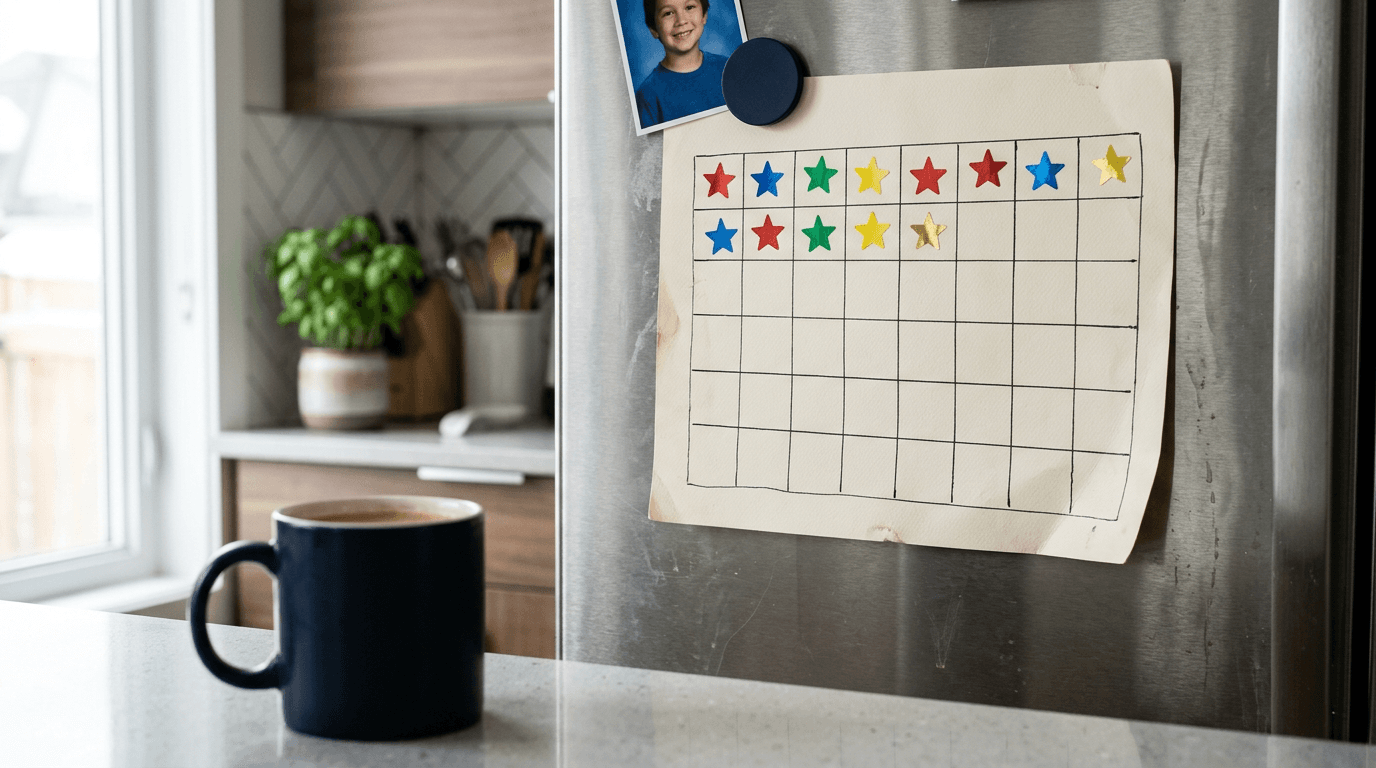
You remember making it.
Sunday afternoon. Good pen. Straight lines. Every kid got a column, every day got a row. You even laminated it, or you told yourself you were going to.
Monday, it worked. Tuesday, it worked. By the second week you were reminding them to check the chart. By the third week you were the only person in the house who knew the chart existed. Now it is behind a school photo and a dentist appointment card, and you have quietly moved on to the next system.
Here is the part nobody tells you: that was not a discipline problem. That was not a your-kid problem. And it was definitely not a you problem.
The chart was built to die on week three. Every one of them is.
What the research actually says about reward charts
Reward charts are not useless. They do one thing genuinely well, and it is worth understanding before we take them apart.
Kids under about seven do not have a working internal sense of progress. Tell a six-year-old they had a good week and it evaporates before dinner. Put five stars on the fridge and suddenly that week is visible, countable, real. That visible feedback loop is the entire active ingredient in a chart, and it is the same reason adults use step counters and running apps.
So charts start strong. Then three things go wrong, in this order.
1. The chart stops moving before your kid does
A sticker on day one and a sticker on day forty look identical. Nothing accumulates. There is no version of your kid on day forty who is further along than the version on day one. The chart records that something happened. It does not build anything.
Kids notice this faster than adults do. Once the chart stops being able to show them progress, they stop looking at it, and a chart nobody looks at is a piece of paper.
2. The reward quietly becomes the only reason
This one has real research behind it, and it is the uncomfortable part.
When you reward a task, kids reorient toward the reward and away from the task. Researchers call it the overjustification effect. In a 2008 study, Felix Warneken and Michael Tomasello found that toddlers who were given a material reward for helping became less likely to help again afterward than toddlers who got praise or nothing at all. The kids who were paid helped less. Alfie Kohn and Edward Deci have been making the same argument for decades from the motivation research side.
Practically, this is why your kid started asking "what do I get?" about things they used to just do. You did not create a greedy kid. You created a price list, and they read it correctly.
3. The chart makes you the enforcer instead of the system
The chart does not remind anybody. You do.
And the second you become the reminder, the responsibility quietly transfers from your kid to you. The parent takes over managing the kid's obligations, so the kid no longer has to track them at all.
Worse, reminders teach a lesson you never intended. If your kid knows five more reminders are coming, the first four do not count. They are not ignoring you. They are correctly reading the system you built, in which the fifth reminder is the one that matters.
That is week three. The chart has stopped showing progress, the reward has replaced the reason, and you are back to being the alarm clock.
Five fixes that actually hold
None of these require an app. Do them with paper if you want. They work either way.
Fix 1. Make progress accumulate instead of reset
Weekly charts wipe the slate every Sunday. That is backwards. Whatever you track, make it build: total days, a running streak, a level, a number that only goes up. The kid needs to be able to point at something and say "look how far I am," not "look what I did this week."
And never take back something they already earned. Removing a star a kid has earned breaks the entire system, and it is the single most common way parents kill a chart without realizing it.
Fix 2. Define "done" before you assign it
Half of all chore fights are not defiance. They are two people working from different rulebooks.
You said clean your room. They heard clear a path to the bed. Neither of you is lying. Nobody wrote down the standard.
Before a task goes on any list, define what finished looks like in a sentence a kid can repeat back. "Bed made" means blanket flat, pillow at the top. That is it. You will lose ten minutes defining it once and get back an hour a week arguing about it. Starting from chores that actually match your kid's age makes this much easier, because the standard is reachable in the first place.
Fix 3. Get the reward off cash
Parents are genuinely split here. In the 2022 T. Rowe Price Parents, Kids and Money Survey, about 79 percent of American parents gave their kids an allowance, and among those who did, 59 percent thought the money should be earned through chores. So roughly four in ten paying parents deliberately keep the two things separate.
The problem with cash is not the money. It is what it turns the house into. Behavioral economist Dan Ariely frames it as market norms replacing social norms: once you pay, the question becomes what happens when your kid starts thinking of family life as a job. You end up with a kid who negotiates a rate for brushing their teeth, which is a strange thing to have taught someone.
Pay them for the big stuff if you want. Keep the daily habits out of the transaction. (The full case against paying for chores is here.)
Fix 4. Get the reward off screen minutes too
We have all traded twenty minutes of iPad for a set of clean teeth. It works right up until it does not.
A UCSF team led by Jason Nagata studied 10,054 twelve and thirteen year olds and found that using screens as a reward or a punishment was associated with more screen time, not less, along with more problematic video game use. Limiting and monitoring screens worked. Using them as currency did the opposite.
The logic is simple once you see it. When screen time is the prize, screen time becomes the most valuable thing in the house by definition. You have not reduced how much they want it. You have officially confirmed it is the best thing available.
Rewards that hold up better: choosing dinner, staying up thirty minutes late on a Friday, picking the weekend activity, a family ice cream run they earned as a group.
Fix 5. Take yourself out of the reminder loop on purpose
Stop delivering the task. Point at the system that holds the task.
One question, asked the same way every day, beats five reminders. "What is left on your list?" is a question a kid has to answer for themselves. "Go brush your teeth" is a task they can wait you out on.
The goal is not a kid who obeys faster. It is a kid who checks something other than your face to find out what they are supposed to be doing. (We wrote a full guide on getting chores done without nagging.)
So how close is your chart to dying?
Five questions. No email required to see the answer.
Why any of this matters more than a clean house
Marty Rossmann at the University of Minnesota followed 84 kids across four points in their lives, from preschool through their mid-twenties. The kids who started doing household tasks around age three or four were the ones most likely to end up self-sufficient, with solid relationships and early career traction.
Not the ones with the neatest rooms. The ones who got early practice at being responsible for something.
That is the actual point of all of this. Nobody is fighting about a hamper because the hamper matters. You are trying to raise a grown-up. The habits are just where grown-ups get built.
Where SmartChores fits
Straight up: SmartChores exists because I built a chart, watched it die on the fridge, and got tired of being the alarm clock in my own house.
I run a Taekwon-Do school. I have spent twenty years teaching kids discipline through structure, and it works there because the belt system does something a chore chart never does. Progress accumulates. A kid can see exactly how far they have come and exactly what is next. Nobody has to nag a kid to want their next belt.
SmartChores is that system, aimed at the stuff that actually happens at home.
Kids earn XP and SmartCoins for completing their chores. XP levels up their character. The character levels up their Sidekick, which evolves through five stages. Streaks build. Badges unlock. The progress is theirs, and it never resets to zero on Sunday.
Which maps onto the five fixes directly:
- Progress accumulates instead of resetting (fix 1)
- Every chore has a standard you define once (fix 2)
- SmartCoins buy rewards you choose, not cash (fix 3)
- You decide what the coins are worth, so it never has to be screen minutes (fix 4)
- The app holds the list, so you get to ask one question instead of five (fix 5)
My seven-year-old actually helped design part of it. Feeding the Sidekick with SmartCoins was his idea.
The honest part
SmartChores is on a screen. I am not going to pretend otherwise in a post where I just told you screen time makes a bad reward.
The difference is what the screen is doing. It is not the prize. It is the place the routine lives, so the routine stops living in your voice. Your kid opens it to find out what is left, not to get paid in minutes.
If that distinction does not sit right with you, use paper. Just make the progress accumulate and stop taking stickers away. That alone will get you further than the last chart did.
And if you want the version that runs itself, SmartChores is free for 7 days on the App Store or Google Play. No charge today, cancel anytime.