
Open any chore guide and count how many sentences it takes before the word "siblings" shows up.
Rotate the jobs. Split them by age. Make it a race. Put up a leaderboard.
Great. You have one kid. The only other people in the house are you.
A parent asked this online recently, and it is a better question than it sounds: with one kid, do you help them with their chores, or is it 50/50?
Full disclosure: I have two boys, so this one is not from my own kitchen. It is from twenty years of teaching other people's kids, where every student lines up on their own and the only person they are trying to beat is the one who showed up last week.
That turns out to be the whole answer. But let's start with what is actually different.
What changes when there is only one
There is no rotation. In a house with three kids, the job nobody wants moves around. In your house, it belongs to your kid forever, or to you forever. Neither is great.
There is no comparison. No "she already did hers." That is mostly a gift. It also means your kid has no way to see what normal looks like for somebody their size.
The team is two adults and one kid. That makes it easy for the kid to slide into one of two roles: the guest who gets served, or the third adult who gets treated like a roommate. They are neither.
It is easier to just do it yourself. One kid makes a small mess. Picking it up takes you ninety seconds. That is the trap. Ninety seconds a day, for ten years, is a kid who never learned to do it.
The answer to 50/50: neither
Stop splitting the work evenly. Sort it into three kinds of jobs instead.
Jobs they own
Theirs alone, start to finish. Nobody helps. Nobody finishes it for them.
Their bed. Their bag. Their clothes in the hamper. Plus one job that serves the whole house, like feeding the dog or emptying the wastebaskets.
That last one matters most. A kid who only ever cleans up after themselves is tidy. A kid who does a job the whole family depends on is needed. Those are different feelings, and the second one is the one that sticks.
Do not help with an owned job. The second you step in, it is your job again.
Jobs you do side by side
Dinner cleanup. Folding laundry. Raking the yard.
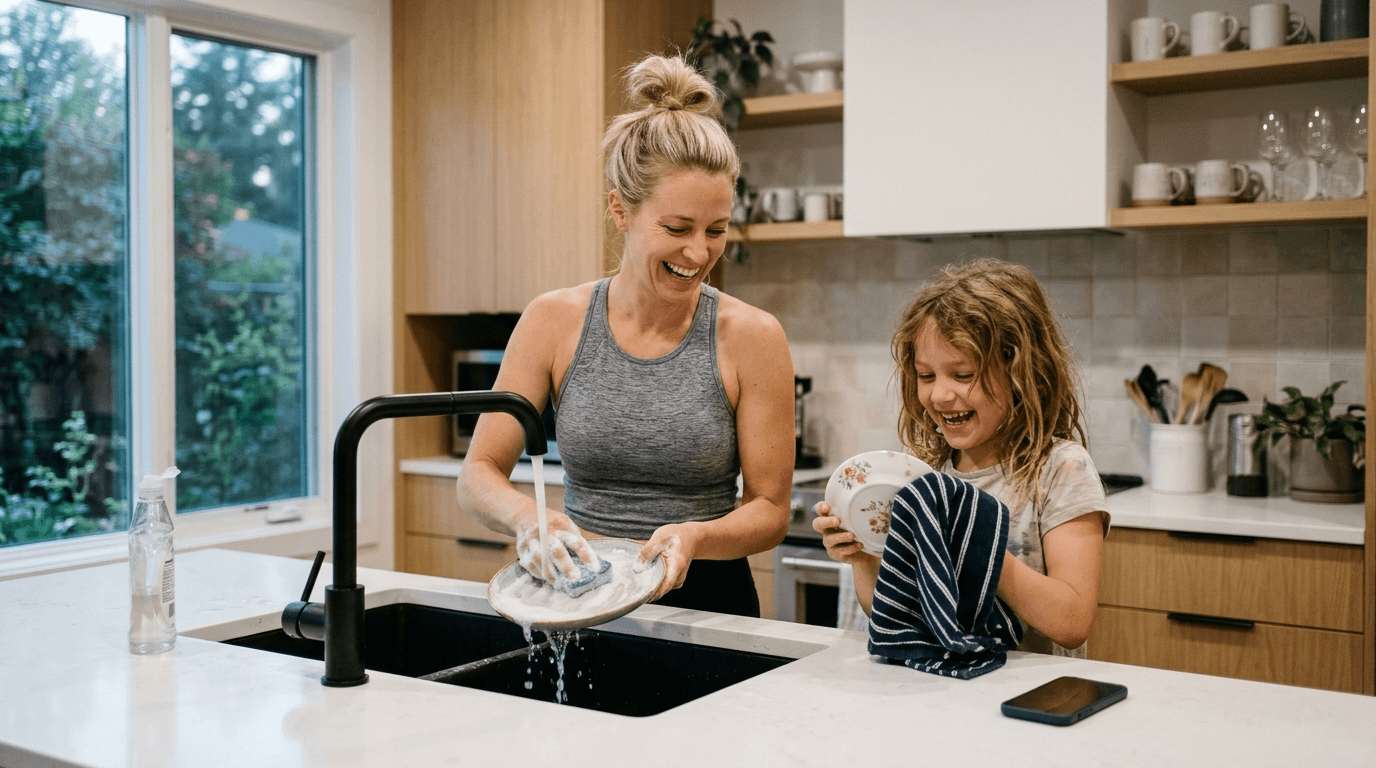
This is not you helping with their chore. It is two people on the same team doing a house job together. You wash, they dry. You fold the sheets, they match the socks.
For an only child, this is the piece that replaces the sibling. Not the competition. The company. Some of the best conversations you will ever have with your kid happen over a sink, when nobody has to make eye contact.
Jobs that are yours
Here is one only kids miss out on. In a bigger family, kids see the work getting divided up all day long. In yours, a lot of it happens while they are at school or asleep.
So say it out loud. "I have the dishes. Dad has the trash. You have the table."
The pediatric team at Children's Wisconsin frames it as the family being a team where everyone contributes. Your kid cannot feel like part of a team if they cannot see anybody else playing.
Rotate with the adults
The job nobody wants still needs to move around. So rotate it through all three of you.
This week the kid has the bathroom sink. Next week you do. The week after, your partner does.
Your kid watching you take your turn at the worst job in the house teaches fairness better than any speech. And it kills "why do I always have to" before it starts, because they do not always have to.
Compete with yesterday
No sibling means no race. Good. Races between kids of different ages were never fair anyway.
Give them something better to chase: their own record.
- A streak. How many days in a row did the bed get made?
- A timer. Room picked up in six minutes yesterday. Can it be five today?
- A level. Something that goes up and never resets.
This is exactly how a belt system works. Nobody earns a belt by beating the kid next to them. They earn it by being better than they were three months ago. Kids will work hard for that, as long as they can see it. (Charts that reset every Sunday are why most chore systems die.)
Do not overload them
With no other kids around, it is easy to forget how old yours actually is. An only child spends a lot of time with adults, talks like one, and gets handed adult-sized expectations.
Match the job to the age, not to the vocabulary. A typical seven-year-old can feed a pet, fold towels and unload the dishwasher. They cannot run a household. (Here is the full age-by-age list.)
Do not underload them either
The other direction is just as common. One kid, small mess, busy week. You do it all, and the weeks turn into years.
Marty Rossmann at the University of Minnesota followed 84 kids into their mid-twenties and found that the ones who started household tasks early were the most likely to end up self-sufficient.
The study did not ask how many siblings they had. The practice is what mattered.
Where SmartChores fits
Straight up: three lists on a piece of paper will get you started tonight.
SmartChores is built around one kid and their own progress, which is why it works without a sibling in the picture. Your kid picks a character. Chores earn XP and SmartCoins. XP levels them up, and their Sidekick evolves through five stages. Streaks build. Badges unlock.
All of it is measured against one person: the kid they were yesterday.
You choose the chores and the rewards. They check the list instead of checking your face.
One kid. One Sidekick. One streak.
SmartChores is free for 7 days on the App Store or Google Play. No charge today, cancel anytime.